After finally banking over eight hours of sleep, I woke feeling almost human again. It was glorious.
Today brought another round of high suspension bridges, but what really marked the day was the sudden surge in mule traffic. I learned three things about mules:
First: they are mean. Or at least they behave meanly, perhaps because of how they’re treated. Either way, they don’t hesitate to shove. Yesterday one pushed a tourist clean off a bridge. Luckily it wasn’t a high one, so the guy walked away with little more than bruises—but it was a vivid reminder never to be caught between a mule and a cliff. We spent hours scrambling onto rocks and ducking behind barriers, giving them wide berth.
Second: the trail takes its toll on them too. I saw several with raw, injured front legs today. Tragic, and hard to watch.
Third: mules don’t do altitude. Within a day or two they’ll vanish from the trail, replaced by yaks and horses better suited to the thinner air.
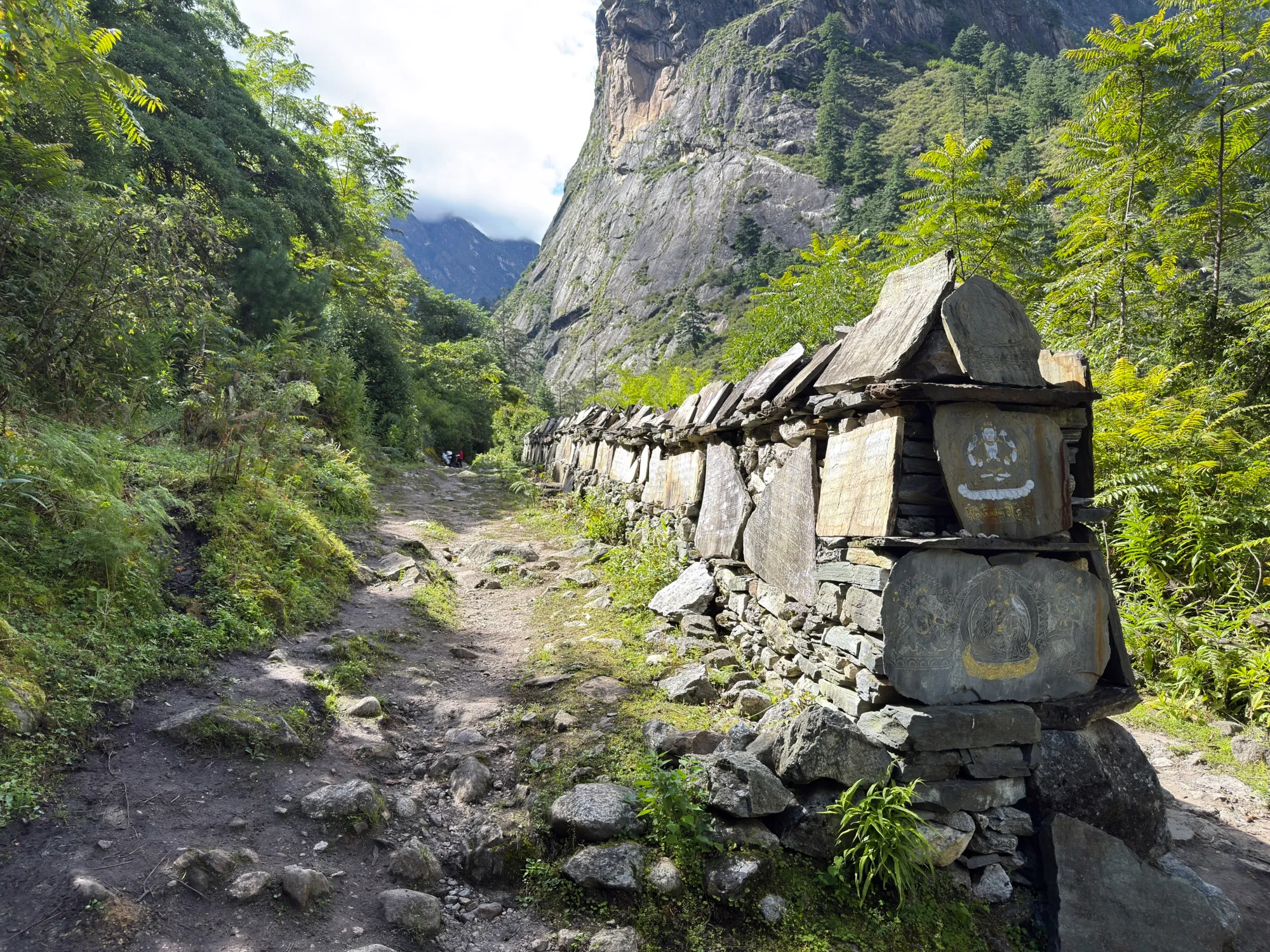
There was also a marked cultural shift today. Up to yesterday, Hindu shrines dominated, with barely a Mani stone in sight. This morning, though, the landscape changed—stupas at village entrances, Mani walls lined with carvings, and people whose features and language felt distinctly Tibetan. My guide insists the practice of keeping the stupa on your right as you pass is practical rather than mystical; when one was overgrown with stinging nettles, he simply shrugged and said, “Not practical,” and we walked on.
It was blistering hot—30°C on the trail—and I had foolishly switched to heavier trail pants after the cold night. Within an hour they were rolled to my knees. My sun hoody spared me from fresh burns, though it left me roasting inside two sweaty layers. Sunscreen here is useless—it sweats straight off.
Speaking of nettles, I made their acquaintance today. Two lessons: first, they sting like fire; second, they grow at face height. A truly miserable design. I’ve filed this under “experiences to avoid for the rest of my life.”
The Mani stones themselves were fascinating. Some stretched for hundreds of meters, like spiritual dual carriageways dividing the flow of traffic: clockwise on one side, counterclockwise on the other. While most bore the mantra Om mani padme hum, I also spotted Buddhas and unfamiliar inscriptions. My mind drifted to the Ea-nāṣir complaint tablet—what would a Himalayan equivalent look like? Perhaps one carved with, “Why is everything uphill both ways?” Or maybe a buyer’s warning not to trust the yak dealers in the next village.
Lunch confusion struck in Ghap. Or rather, in two Ghaps.
Me: “Where do we stop for lunch?”
My guide: “Ghap.”
Two hours later, a sign: Ghap.
Me: “Great, lunch time!”
My guide: “Not this Ghap. Other Ghap.”
Cue confusion. Apparently, you pass through Ghap, cross a river, and then eat in… Ghap. I began to wonder if my guide had been chewing nettles.
After Ghap came the high jungle—lush, dense, and magical at 7,000–8,500 feet. Towering trees, endless ferns, mushrooms the size of thumbnails and dinner plates. It felt like stepping into a natural cathedral. Best of all: no mosquitoes. Worst of all: Nepal’s trail-building tradition of scattering jagged, loose rocks everywhere. My legs worked overtime to avoid falling, while a cricket chorus (clearly tipped off by yesterday’s heckler) followed me for two straight hours.
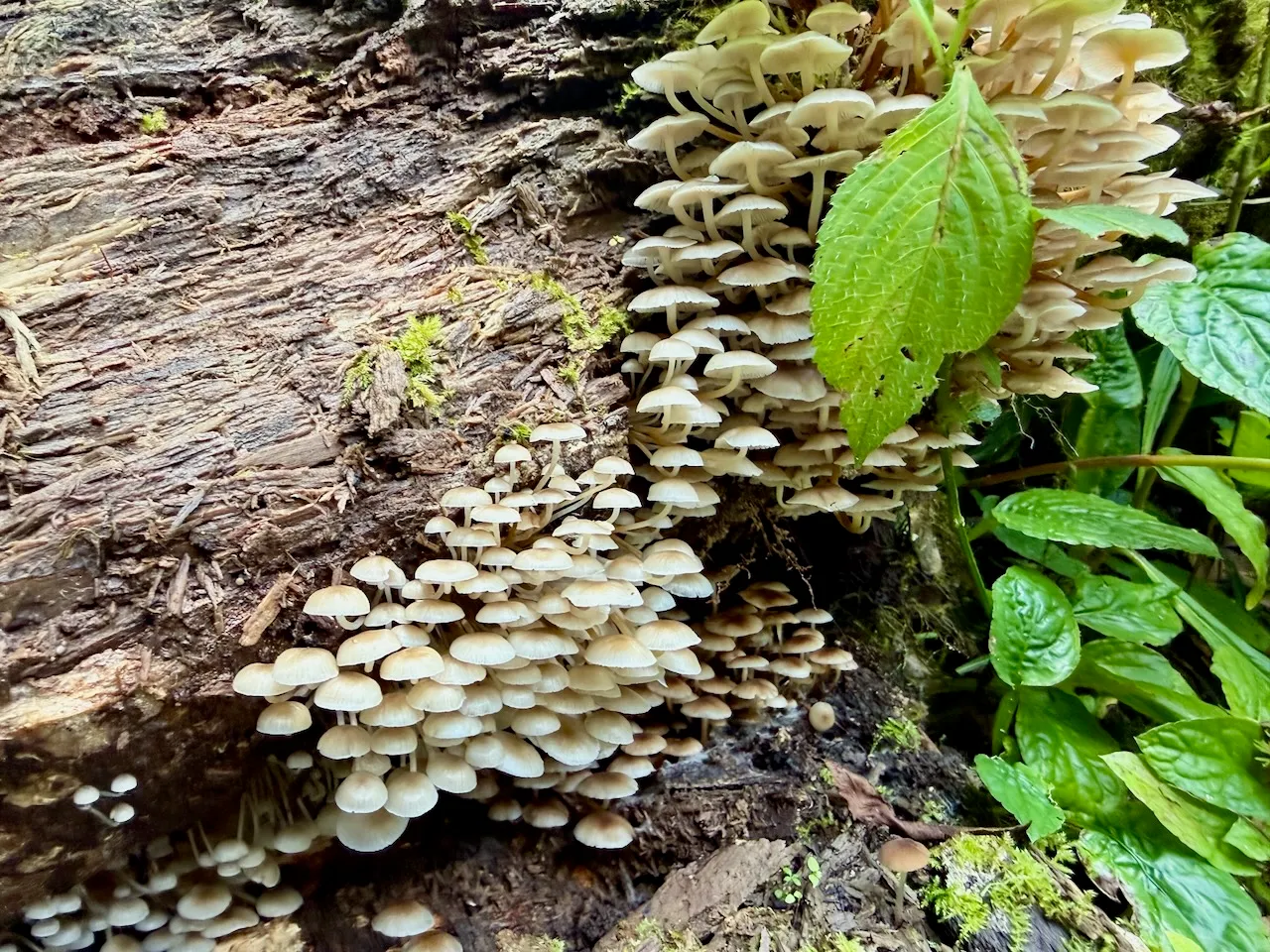
Tiny little mushrooms
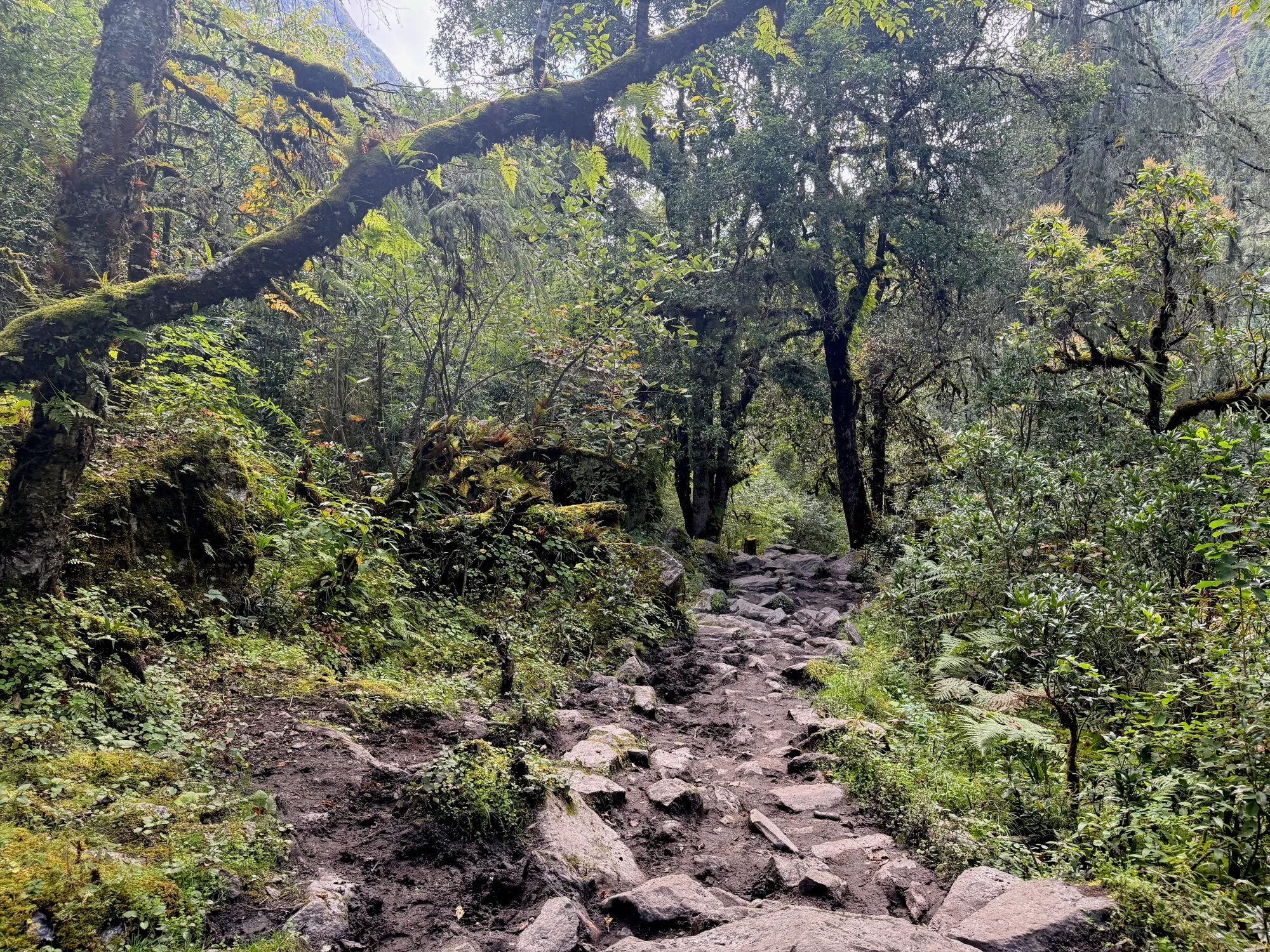
Nice smooth trail
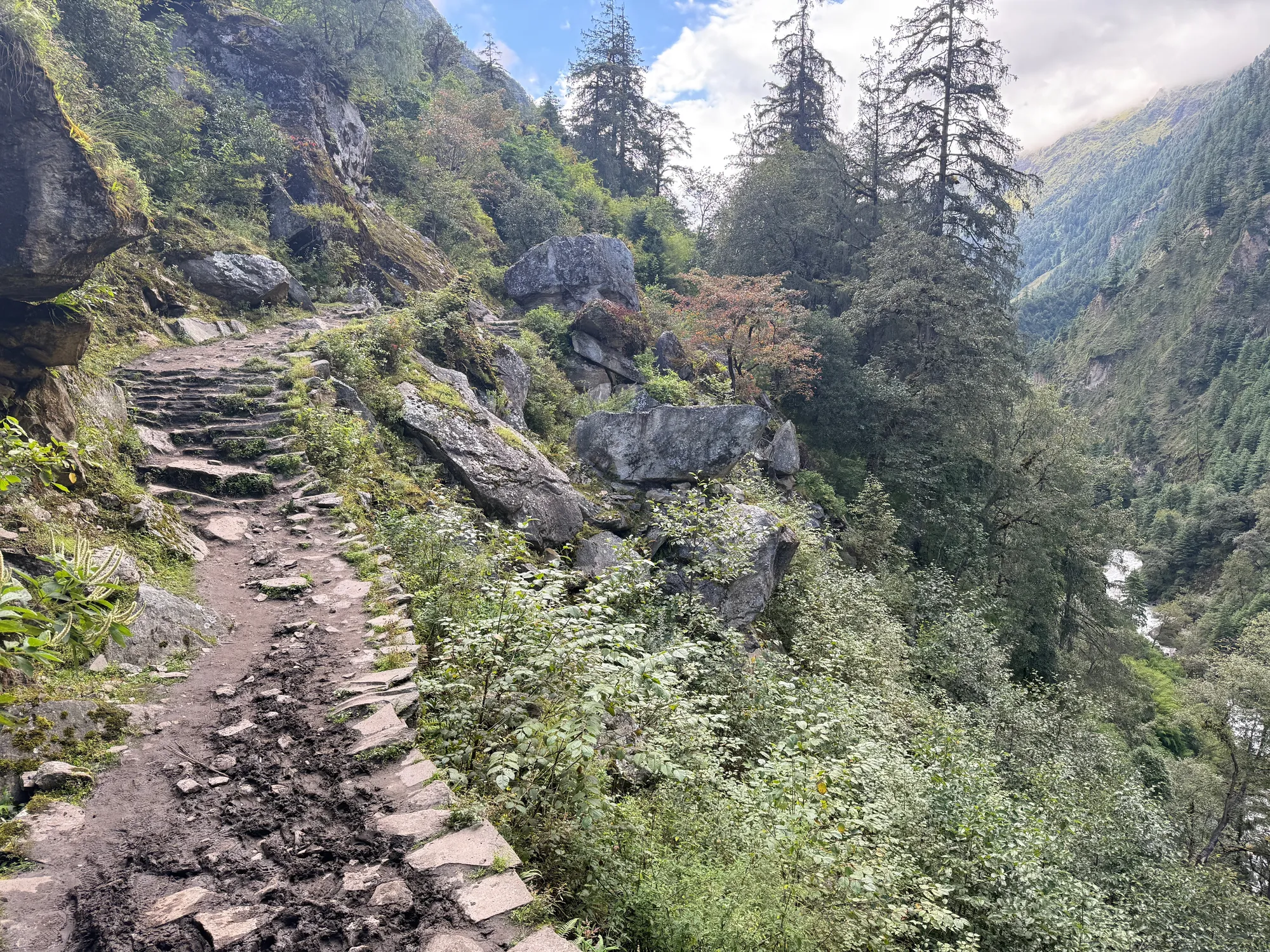
Scenic path
The final three miles to Namrung were stairs. Endless stairs. Some knee-high, others absurdly tiny—two inches deep and barely wide enough for my toes. Each step demanded full-body effort, every muscle tense in case a boulder shifted underfoot. More than once my trekking pole dislodged rocks the size of toddler bathtubs. My new technique: jab first, test stability, then risk a step. To make things more interesting, sections of the path simply became a river. At least my Gore-Tex Nikes kept the outside water out—even if the inside was already soaked with sweat. Two pairs of socks a day helps with this particular problem.
Half an hour before Namrung we stumbled across an organic apple farm. I treated myself to a Sprite and bought my guide and porter their preferred drink: freshly pressed apple juice. It looked delicious, but my fear of food poisoning won the day. We met a guy who had climbed Everest five times at the farm.
Namrung itself is a strange mix of charm and emptiness. In ordinary years it’s tourist central; now, after the tragedy of September 8th in Kathmandu, it’s hauntingly quiet. I had an entire three-story wing of a tea house to myself—brand new, with an en suite western toilet and an ice-cold shower that left me shivering for an hour. I suspect it’ll be my last proper shower for at least a week, and almost certainly the last western toilet until Kathmandu. It still amazes me that every brick, pipe, and pane of glass up here has been carried by mule or human back. Beds, chairs, tables—everything wooden is cut locally, but above the treeline even that luxury disappears. Higher up, yak dung becomes fuel.
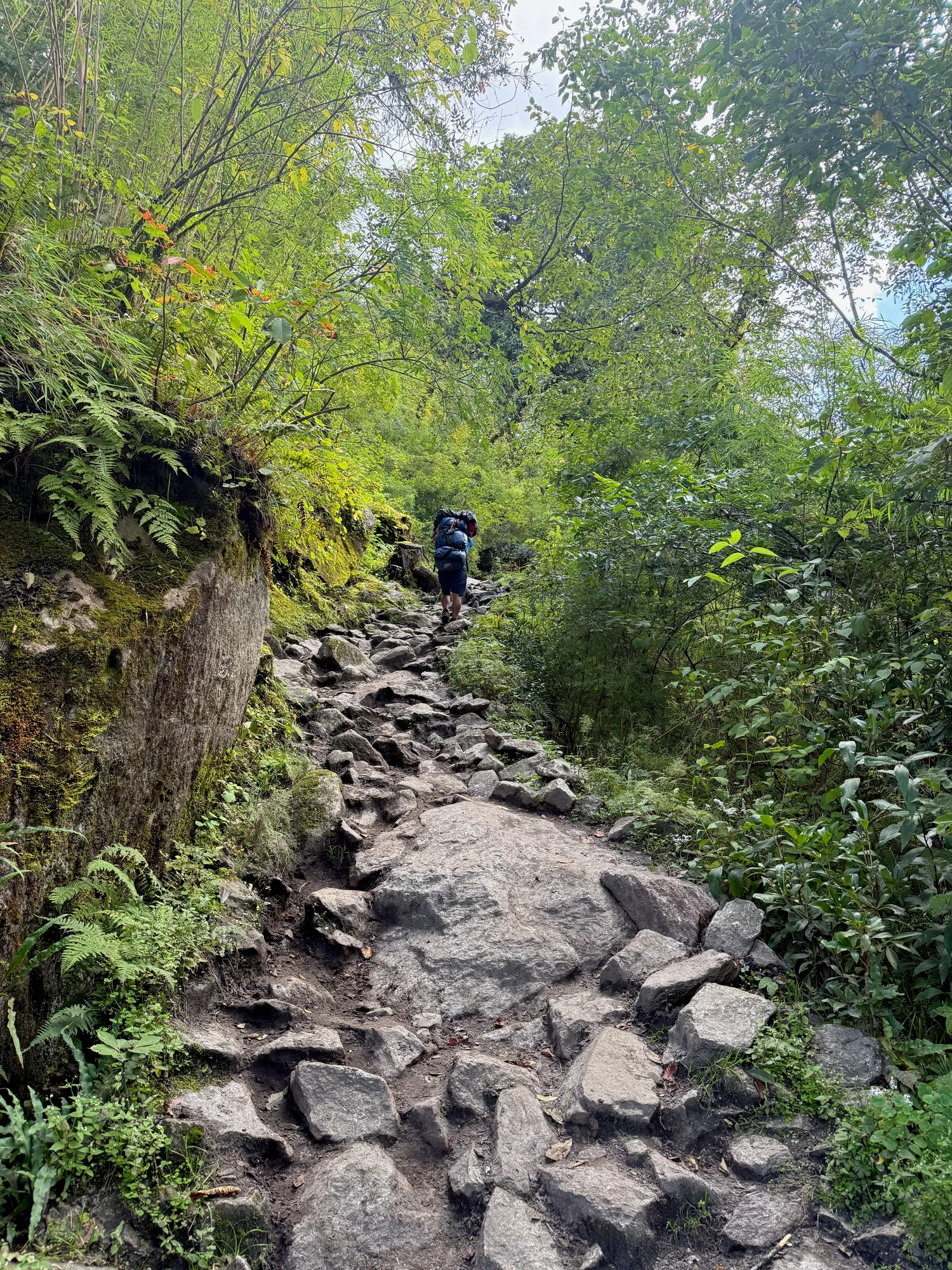
Approximate stairs
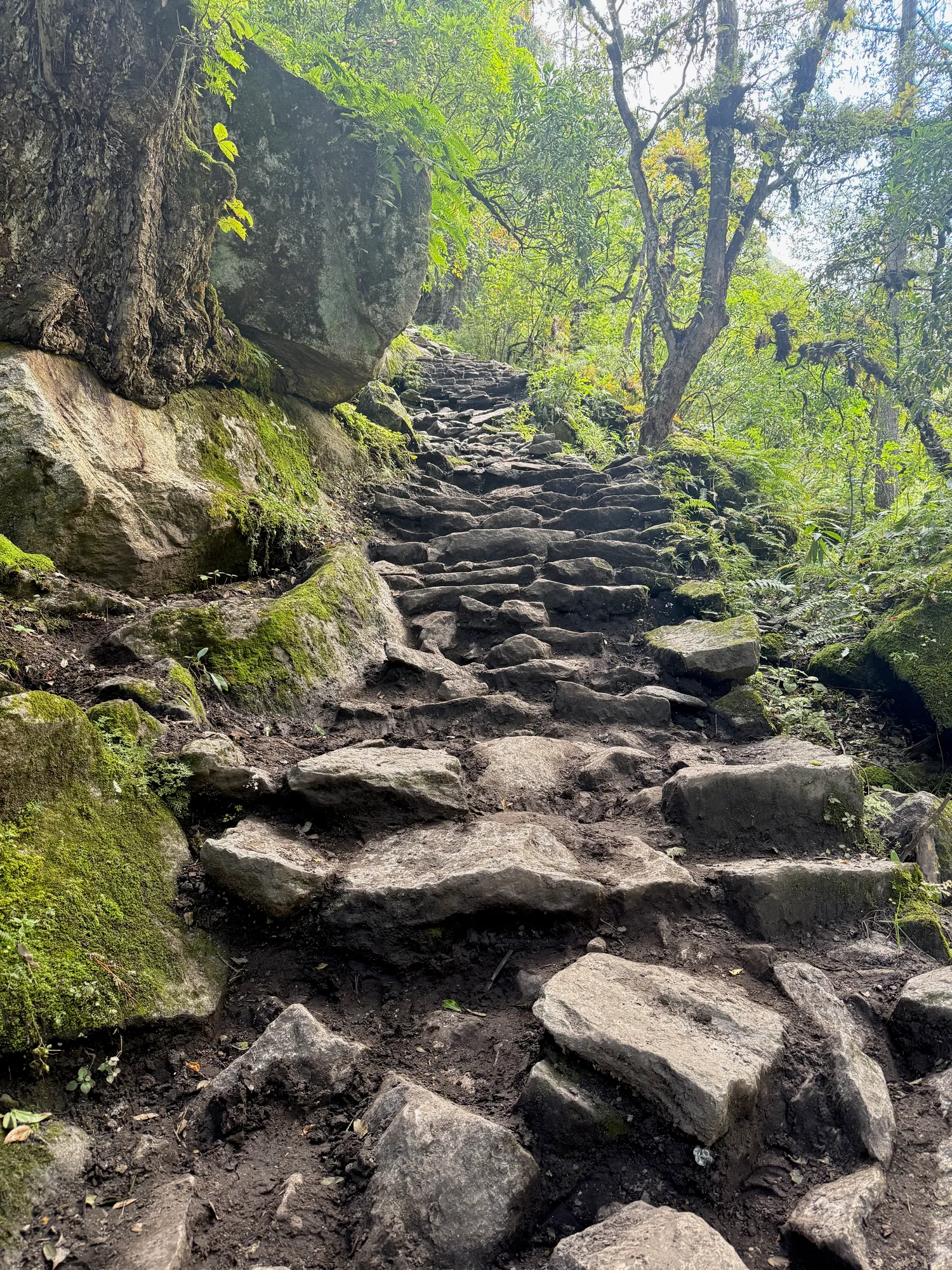
Stairs
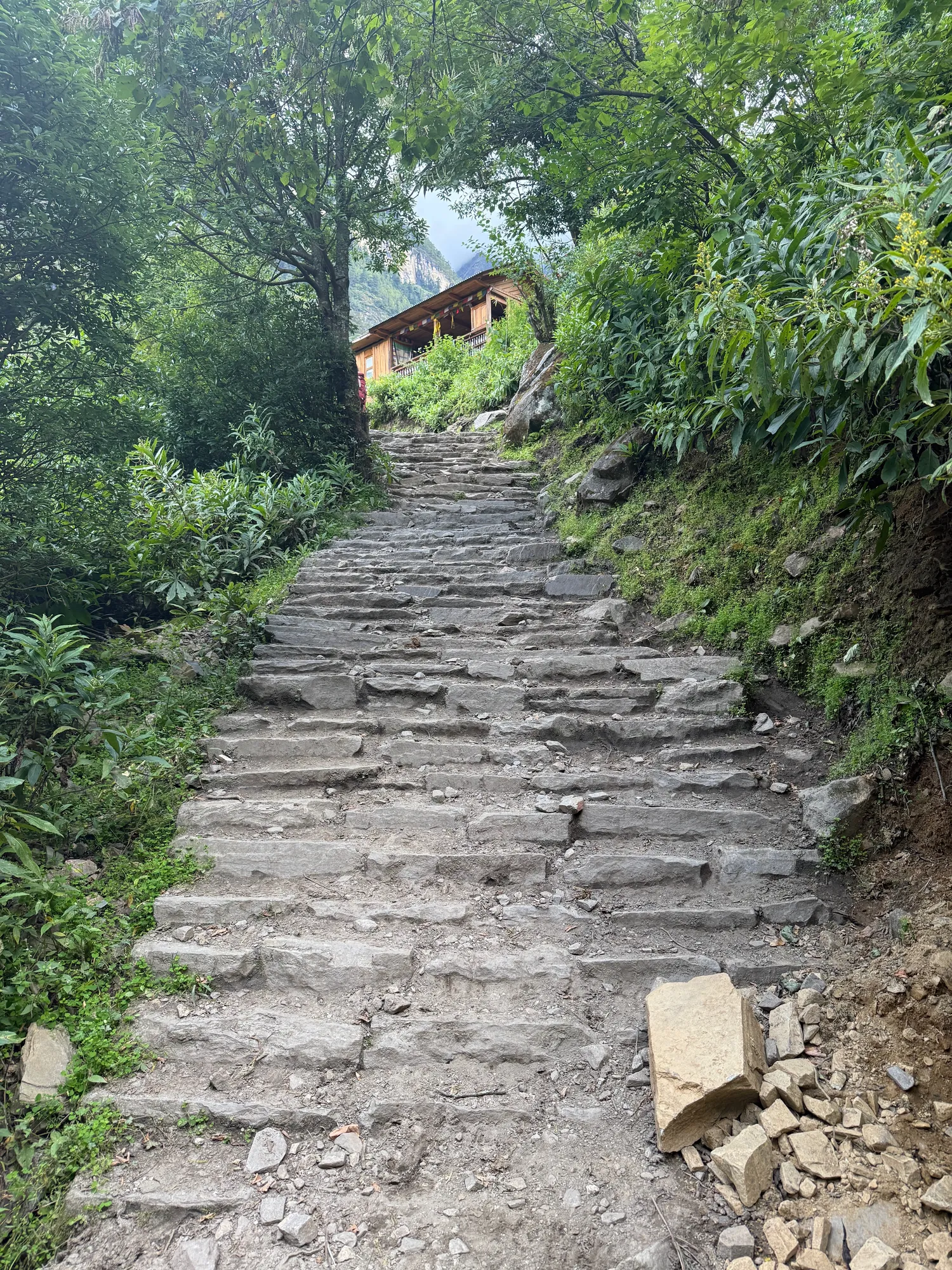
Stairs
Dinner was dal bhat, shared quietly with my guide. The South Africans opted for the local “Four Seasons Resort,” which has more of a “Four Seasons Total Landscaping” vibe than anything seen in White Lotus. My guide, usually shy, finally opened up about his family and life in Nepal. It felt like the beginning of friendship.
As for me, I’ve developed a complicated relationship with LMNT electrolyte powder. It works—no cramps at two sachets a day—but the taste is ghastly. Imagine Dead Sea brine with a hint of artificial fruit. They recommend mixing it with 0.5L of water; I need at least a liter just to gag it down. Worse, it leaves me thirstier with every sip. My current solution: grimace, sip, then immediately dream of drinking plain water.
Stats of the day: Whoop strain 20.7. Sweat loss: 7.2 liters. Coke/Spite consumption: 2.5 liters. Water: 3.5 liters. Number of monks spotted: one—cheerfully greeting me with “G’day, mate,” in an Aussie accent, grin wide because he knew I wasn’t expecting that.
And finally, today’s new theory: mule droppings have a half-life of about 48 hours in the high jungle. After that, they simply merge into the jungle floor.
This is the GPX and heart rate data for the day, as usual, drawn with altitude and temperature. There are two today - one covering the Deng to lunch time, then lunch time to Namrung. I was fairly cooked by the time we hit both Ghaps, and instead of hitting pause for lunch, I ended the first tracking session.
Deng to Ghap
The morning was classical Nepalese up-and-down torture. Go ahead and zoom in to see the Ghap / Prok / Ghap villages.
Ghap to Namrung
No more up-and-down torture this afternoon, it was just plain walk-up-endless-stairs torture.
Volatren and Ibuprofen continued today. 400mg of Ibuprofen at 5pm, with Voltaren on the shoulders at about 7am, 1pm and 8pm. No new blisters today, but the large one on my left thumb popped leaving me with the choice between face planting or twisting ankles on loose trail rocks without trekking poles or a constant sharp stinging in my thumb. The trekking poles stayed.
Electrolytes:
- 2x LMNT
- 2x SaltStick chews
- 4x Propel 0.5l of water packets
Food:
- Breakfast: the usual 2x MET-RX Super Cookie Crunch. 820 cals, 84g carbs, 42g protein.
- Dal Bhat for lunch: I skipped the mystery veg as it was neither cooked nor warm. I also skipped the Dal - so just a cup of rice and half a handful of potatoes. Maybe 450cal.
- 2.5L of coke, 55g of carbs
- Afternoon snack: Clif Bloks (about 45 min before starting the stairs)
- Afternoon snack (after arrival in Namrung, before dinner): Kars trail mix pack + 2x chocolate squares.
- Dal Bhat for dinner: mystery steamed veg was good. Dal seemed good. Pickled carrots with just enough spice. Potatoes and rice fine. Maybe 520cal.
No wifi today, and extremely limited cell coverage (Edge network for an hour or so) in Namrung.