I’ve enjoyed my time in Kathmandu and on the Manaslu Circuit. It’s a very different feeling to when I visited India with my wife a couple of years back. While I loved India’s history and architecture, I remember being desperate to leave by the end. There was nothing I wanted more than to get to Delhi airport. To this day, I don’t know how my wife managed to tour India for over six months without going mad.
Nepal, on the other hand, feels both familiar and completely different. I’m writing this a day before I depart, and instead of feeling eager to escape, I’m sad to be leaving. The people I’ve met have been consistently warm and kind. Even the so-called tourist-trap traders in Thamel are relaxed and friendly rather than aggressive. One evening, walking to a cashmere shop, I tripped on an invisible hole filled with water in the dark. Immediately, two young men came over to check if I was okay. In the shop itself, the entire scarf-buying transaction was calm and straightforward. No pushing, no fake confusion over change, no relentless upselling—just genuine friendliness. It was such a contrast to my experience in India.
That calmer spirit carries onto the roads as well. In Delhi, Jaipur, and Agra I remember aggressive driving, constant honking, and every car fighting to be the main character of the story. In Nepal, drivers also invent five lanes out of two, but it’s done with shrugs, not anger. Horns are used as warnings—especially on blind corners—not as weapons. Oncoming drivers simply slow, shift over, and carry on. No road rage, no screaming. Just coexistence.
And yet, from my hotel room in Kathmandu, I can see a burnt-out NCell tower—torched less than a month ago in the so-called Gen-Z uprising. Hundreds of buildings were damaged, dozens of people died, and the protests forced a change of government. Two weeks later, I walked calmly through the same city, which seemed entirely at ease, quietly moving forward. On the trek, locals spoke about the uprising with hope—that elections would bring improvement, that Nepal’s future might be better.
The drives in and out of the mountains revealed another side of Nepalese life. Compared to South Africa, the cars here are newer, better maintained, and surprisingly often electric—mostly Chinese BYD, with a scattering of Japanese, Korean, and Indian brands. American and European cars are rare. In the villages, especially during festival season, people gathered in small groups, smiling, laughing, talking. The contrast to South Africa struck me immediately: no visible simmering anger, no edge of desperation. Even compared to India, there seemed to be less of that hustler’s mask of forced charm hiding frustration.
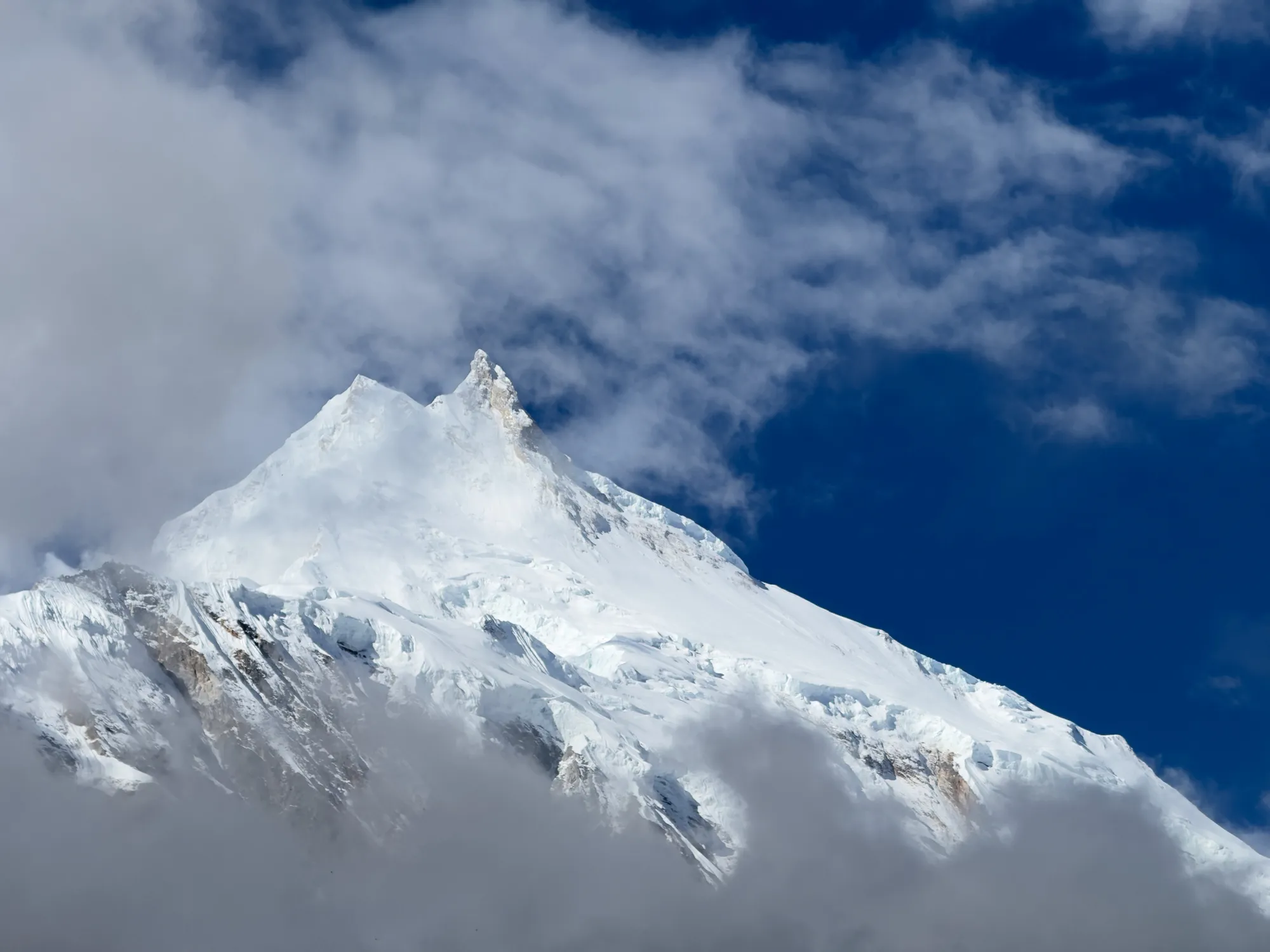
And then there is the physical beauty of Nepal. Few countries can rival its variety—towering peaks, lush valleys, thick forests, jungles, and sweeping plains. To walk through it all on foot felt like an extraordinary privilege. Yet the Manaslu Circuit may not remain this way much longer. Roads are pushing deeper into the valleys. The Chinese are driving a road toward Tibet along the very path I walked, and locals say it could be complete within four years. On the way back to Kathmandu, we drove along 40 kilometers of the Annapurna Circuit. The scenery was staggering, but the “trek” there has become little more than walking on a road, dodging jeeps and trucks. By contrast, Manaslu still belongs to people, mules, horses, and yaks—plus the occasional maddening cricket.
Other famous treks face their own challenges. Everest Base Camp has become overrun, a there-and-back conveyor belt of trekkers. The Annapurna Circuit is now more road than trail. And the Langtang Valley, though beautiful, is still recovering from the devastation of the 2015 earthquake. Manaslu, for now, offers mule trains, prayer flags, and mountain silence. But not for long.
On my second last day in Kathmandu, I stopped by the office of my trekking company to pay tips and share my experience. The director told me he was facing a difficult season—over a hundred booked tours had been canceled following the Gen-Z protests, after foreign governments advised their citizens to stay away. I find it hard to reconcile that stance with those same governments’ acceptance of Nepal’s new leadership. While it has been calm and peaceful during my time here, elections are coming, and it’s possible things may flare again. Still, the gap between foreign advisories and the reality I’ve seen on the ground is striking.
He also shared an insight into why Cathay Pacific had canceled all flights to Nepal for September. One of his clients worked for Cathay and explained that, on the day of the protests, a crew traveling together in a taxi-bus had been caught up in the demonstrations. They weren’t directly attacked, but the experience was frightening enough that no Cathay crews agreed to fly to Kathmandu for the rest of the month. It was a reminder of how perception—especially fear—can reshape an entire season of tourism.
I also met my guide one last time. He was heading back to Manaslu with a new group the next morning, smiling as he told me how glad he was to return to the valleys. Watching him leave, I was struck again by how this place, which for me was a once-in-a-lifetime trek, is simply his home.
October 4, 2025. Written from the rooftop bar of my hotel, watching a lightning storm roll over Kathmandu.